
Overview
Background
In the recent decades, innovation has taken the front seat to driving the direction that the world takes. However, critical thinking, in the above scenario, is crucial to determining the value and balance that one would get out of these innovation strategies.
What’s missing here is what has taken pole position ahead of innovation and that is future studies. Futures studies requires working with people to develop “desirable” or “preferred” futures. However, doing so raises the important question of “preferred by whom?”
Just as in the present, the future will be perceived and experienced differently by different people because of their varying frames of reference, situations among complex systems, and access or lack of access to material and immaterial resources. Future Studies observe that all our narratives (stories, scenarios) on social change issues can be classified into recurring groups of images, stories, or policies regarding effects of that change.
A sector that has seen a recent rise in importance has been the healthcare industry. With the world facing a black swan event, stress has been put on preventive care rather than reactive care. What has been made clear in these recent times is that if a support system of preventive care is built around a probably/current patient, a pandemic can be prevented. Having observed the power of preventive care, this method calls for its application in chronic care, particularly in Cardiovascular Healthcare.
Access to healthcare is a fundamental right of every individual irrespective of their age, gender, place in society or even if they have been incarcerated. This is the premise in which this project explore future possibilities of cardiovascular healthcare in a specific setting of a prison.
Introduction
The concept of prevention being better than cure has definitely gained a lot of popularity over the last few years. Promotion of healthy lifestyles and the prevention of ill health is a fundamental principle behind public health. This also forms the grounds where modern medicine can change from being extremely reactive to being proactive. The purpose of preventive healthcare is to shift the focus from treating sickness to maintaining wellness and good health.
“According to the U.S. Centre for Disease Control and Prevention (CDC), 7 out of 10 Americans die each year from chronic diseases, many of which are preventable.” A similar scenario follows through the rest of the globe. The common chronic illnesses that populations struggle with are Cancer, Diabetes, Asthma and most importantly Cardiovascular Diseases.
Taking a look at under-served and potential at-risk populations, it becomes evident that justice-involved populations are posed with odds that do not favour cardiovascular health. Existing evidence suggests that prison populations have average-high CVD risk compared to community dwellers. Self-reported data from the Bureau of Justice Statistics (BJS) suggest that inmates have increased rates of CVD risk factors compared to demographically- matched individuals living in the community.
This project delves into the potential risks of cardiovascular health in incarcerated populations, exploring preventative care and designing for the future.
Unpacking the problem
A problem always presents itself in a complex form and requires to be broken down. To understand the specific dimensions of the challenge at hand - the 5Ws model was adopted.

Identifying Knowledge Gaps
Quintessential to any project is understanding one’s skills and knowledge gaps to better prepare for the challenges the project may present with. A small exercise to identify these skills and gaps was performed. In order to find gaps in understanding the challenge, a Johari Window Model was made use of.
Known to others
Unknown to others
Known to us
Unknown to us

Setting the Future Scenario
Designing for the future requires setting a very specific context where the challenge will be tackled. The time set for this project is the year 2035, which is about 15 years in the future.
Scenarios are one of the backbones of Strategic Foresight and Futures Studies. These are stories about society, technology, and issues emerging in a specific future setting. To understand the criticality, Jim Dator’s Four Futures explains a methodology that bases its strategies by building different future scenarios, with different uncertainties and variables.
One of the biggest lessons to learn from this was that there is no such thing as a “normal” future from which all other futures are exceptions. No “most likely” future, and no “least likely” future either. The methodology speaks about how each of the millions of images of the futures are variations of one of four generic and fundamentally different images. Using the Four Futures approach, scenarios for the future (in 2035) were built.
1. Continuation
This scenario explored efforts to maintain and grow a powerful economy that leads to further polarisation of the planet (rich vs. poor, right vs. left wing ideologies, healthy vs. unhealthy).

Scenario for Continuation in the future
2. Decline and Collapse
The scenario for Decline and Collapse delved into system degradation or failure modes as crises emerge: 3rd world war triggered by global economic competition, fear of further pandemics, and rise of the cyberwars.
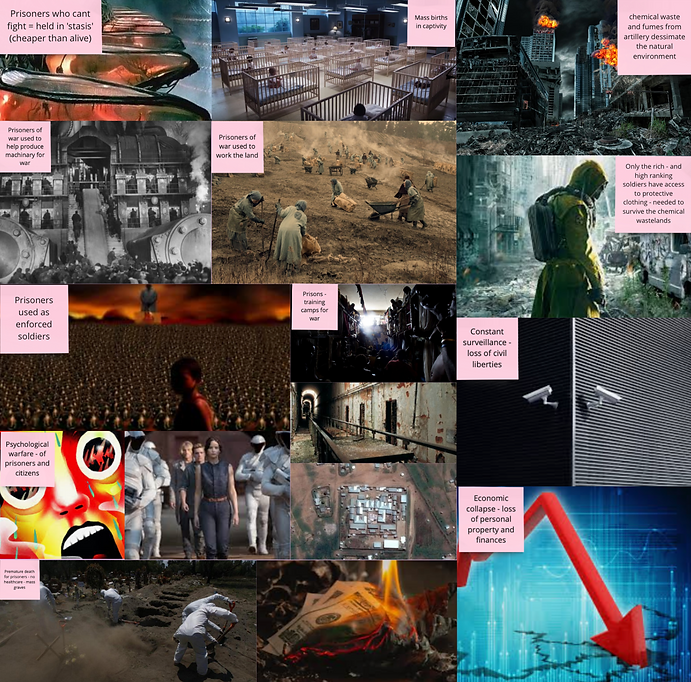
Scenario for Decline and Collapse in the future
3. Limits and Discipline
This scenario explored society being run by puritanical health zealots. Dictated exercise and diet for all citizens and prisoners prioritising over work and economic growth. Subsidising health by paying punitive taxes on ‘fun’, 'Mother Earth doctrine' replacing all religion.

Scenario for Limits and Discipline in the future
4. Transformation
Changing the game with new technology, business, or social factors was the theme of this scenario. Political, legal and health utopia were the motives explored. Another angle that was explored was new natural resources that were found in space helping drive economy on Earth.

Scenario for Transformation in the future
All these different scenarios explored using Dator’s 4 futures highlighted different different uncertainties and variables. It was then time to look at a possible, preferable future to work with. This involved picking out ideals from the four futures to inform a fifth, preferable future.
This was achieved in phases. The first phase involved looking at:
1. The people perspective
Moving towards a holistic lifestyle of nature and health and not restricting people along the way. Finding the appropriate limits of individuals vs. collectivism to ensure the future is not biased. Opportunities to exercise in virtual outdoor domes that synthesise clean air/sensory benefits of natural world was also explored. Incentivising this new lifestyle with free fruit was another interesting angle that was looked into.
The idea was to take forward lifelong learning and embed in individuals high understanding of nutrition/good diet and regular exercise.
For the specific audience being looked at it was essential to establish extra nuances. The fabric for prisoners’ clothing was one such aspect. A concept explored fabric emitting medication/nutritional support.

Exploring bio-domes, prisoner clothes and lifestyle in an alternate world
2. The technology perspective
Leveraging technology to determine personalised healthy food and wellness choices and creating genetically modified, precision nutrition.

Leveraging technology in the new world
3. The social perspective
The picture painted was of a less polarised world, accepting a third way of functioning that included a more diverse range of world leaders. Critically balancing monitoring and protection with loss of civil liberties and surveillance was one of the major challenges to overcome.
Another aspect to be taken care of was managing and countering disinformation and/or fake news.
More equally shared resources, prisons move into space or deep sea to free up land mass. Bioengineered flora and fauna ensuring intelligence amongst all living things.

Building a new society in the preferable future
4. The economic perspective
The main idea here was to try avoiding a huge wealth gap (something on the lines of a scandi-model) and building a new space economy.
A lot of thought was given to medical access - whether it would include robot support, whether medical facilities would be available to all species and robots and increased democratised of open-source healthcare knowledge.

Exploring the overall economic aspect with special attention to healthcare access
Constructing a preferred future
After defining all the various aspects of what society would be like in the year 2035, the next step was to look into modularly building this whole scenario into one singular image of the preferable future.

In the value system of 2035, balance and harmony between humans, nature, science and space form the backbone of society.
Symbiosis between humans, plant form and machines has been established through a synchronous link with personal devices, while maintaining a tricky balance between citizen safety, autonomy and civil liberties.
This society has accomplished so much through an endearing attitude supported by diversity and tolerance. A never-ending pursuit to finding an alternative to ‘right’ and ‘left’ wing politics has led to this era where anyone can become a leader, achieving true cultural, gender, physical and neurological diversity in leadership.
With a paradigm shift came a world where 'Smart Trees' were developed and grown around the world to filter 'bad data’. While the 2020s saw a huge rise in Fake News, Surveillance Cameras and Online Fraud and Manipulation, the year 2035 showed the world an idea of ‘The 5th alternative’.
With an ideal, harmonious setting in society, the harshest form of punishment becomes social disconnection. With prisons set in space, incarcerated individuals find themselves completely dissociated from society and its benefits.
Building concepts for Cardiovascular Health in Prisons in the Alternate World
To build for the future scenario, newer techniques towards design and innovation had to be explored. One such method was Blue Sky Thinking. “Blue sky thinking refers to brainstorming with no limits. With this approach, ideas don't need to be grounded in reality.” Several rounds of crazy 8’s using Blue Sky Thinking were performed and dot voted on.


Backcasting was the next approach taken to build the solution for the preferred future. Backcasting is a methodology that is used when problems at hand are complex. In this technique, the point in future is looked at and then everything in the present is built to reach the defined future.
Another set of Crazy 8s and dot voting took place in the Backcasting methodology.
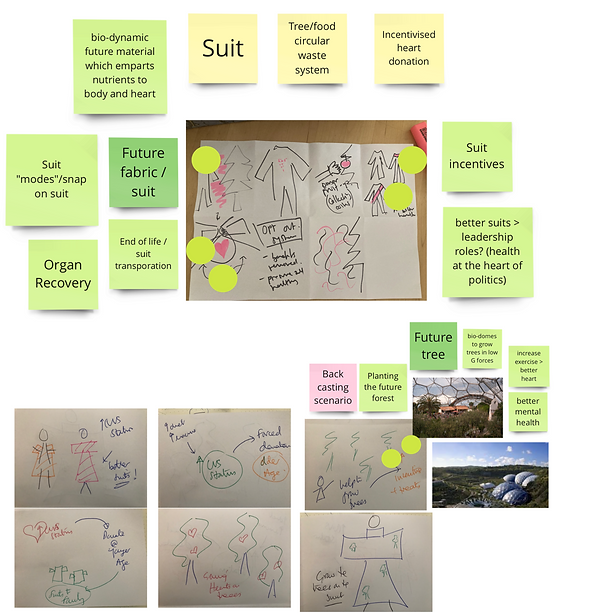

Fleshing out the solution
The solution is not a single product, but an entire system that includes products and services. It entails a Cardiovascular Health Program that is preventative and recovery based.
Talking about the environmental aspect, the solution looks at pods in prison being converted into bio-domes. The latter contains a bunch of flora and is diverse in nature. They are built not only to sustain in the new space environment, regulate temperature, tackle differential gravity, but also to filter nutrients and provide the ideal nourishment that its prisoner requires.

A person’s journey within this space prison begins with an initial Cardiovascular System (CVS) assessment (blood work, EKG, or more advanced ways like Moor’s lab [9] looks at the eye as the window to a person’s CVS health).
Based on the baseline report, prisoners are given their uniforms, which are bio suits that grow onto the prisoner and display their CVS status with colour bands. This suit also performs organ recovery in case a prisoner dies.


The prison ecosystem sustains itself through an incentive and reward system that is based on CVS health. For example, if a prisoner maintains a certain level of CVS health, they get more conjugal visits or social interaction as a reward since prison in space is way worse in terms of isolation.
This prison program also looks at prisoners engaging in physical activity which may include planting trees in bio-domes. This not only boosts the physical health of a prisoner but also their mental health and makes the system self sustaining.

To further add to this recreational cause, prisoners receive added benefits for planting and nurturing plants in the bio-dome. Prisoners give these plants their waste and these plants being technologically smart assess the nutrient requirement of the prisoner and provide precision nutrition to them.

An overview of the future journey was created to bring all the modular components of the solution to one place. This in turn helps get a holistic view of all the features and functions that make up the system and how they interact symbiotically with one another across earth and space.

Future Solution Heat map
The heat map helps understand the impact a system like this will have on users, society, business, environment and technology.

Journey to the future
The first step in this journey has already been made with Petit Pli suits that adapt to growth in children. Adaptation is followed by balanced innovative and critical thinking to
achieve not just a smart living but also intelligent surrounding. However, to advance to this preferred future, developments and awareness towards CVS health needs to be built.
Post this, innovation towards test forests and trial suits needs to be developed. These need to be in tandem with the controlled physical environments in space for which trials on earth will happen first. This may be perfected through the process of iterating.

Success Metrics
As for any solution, success metrics were analysed to inform the viability of the solution. For this step, it was important to evaluate the components surrounding the stakeholders within and around the space-prison ecosystem to understand what essentially is making the system a success.

Future Scope
To fully understand the viability of the proposed solution, the latter was analysed to check for areas that are either ambiguous or require further depth of study to give structural strength to the system.

Conclusion
In a study building for the future, it is essential to understand the role of primary, secondary and tertiary stakeholders as it revolves around CVS health. Speculative design talks about three futures: Possible, Plausible and Preferable. To understand which one of these is most suitable and demanding of the scenario mentioned is crucial. However, something even more important is to look at all the possibilities that the future could hold, the opportunities it presents and the impact it has on pre-designed futures to ensure any solution built is ready for the future.