
Background
The fundamental tenet of health care practice is ‘Do no harm,’ but ironically, the practice of health care itself causes significant pollution, and, consequently, indirect adverse effects on public health, making medical waste a wicked problem.
The health care sector is highly interconnected with industrial activities that emit much of the world’s pollution to air, water, and soil. Estimating emissions directly and indirectly attributable to the health care sector, and potential harmful effects on public health, in 2013, the health care sector was responsible for significant fractions of air pollution emissions and impacts, including acid rain (12%), greenhouse gas emissions (10%), smog formation (10%), criteria air pollutants (9%), stratospheric ozone depletion (1%), and carcinogenic and non-carcinogenic air toxins (1–2%).
The amount of disease burden, unreported and largely unrecognised in health care, was found to be similar in magnitude to annual deaths stemming from preventable medical errors first reported in To Err is Human, which is a topic of national discourse and institutional efforts to improve health care safety in the U.S. These findings underscore the need to measure, mitigate, and educate on the considerable human health and environmental impacts associated with health care practice itself. Efforts to improve the environmental performance of health care can reduce expenditures directly through waste reduction and energy savings, but also indirectly through reducing the pollution burden on public health, and ought to be included in efforts to improve health care quality and safety.
The Current Scenario
Among the various causes of environmental impact that the healthcare domain creates, one of the major ones is direct medical waste.
The various sources of this medical waste is described in the diagram below.
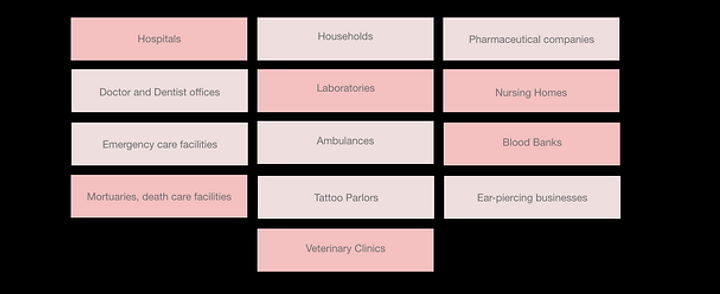
Waste generated by health care activities includes a broad range of materials, from used needles and syringes to soiled dressings, body parts, diagnostic samples, blood, chemicals, pharmaceuticals, medical devices and radioactive materials.

Of the total amount of waste generated by health-care activities, about 85% is general, non- hazardous waste comparable to domestic waste. The remaining 15% is considered hazardous material that may be infectious, chemical or radioactive.

The obvious step forward is to look at what happens to this waste: where it goes and what it’s end game is.

The best practice for medical waste collection and segregation is at the point of generation. This approach reduces the risk of the waste spilling on its way from the generation site to the collection container.
For example, carrying a bloodied gauze from the patient’s bed to a waste container at the end of the room may lead to drips along the way, and is impractical. Use of the right collection containers based on the type of waste is crucial. Placing the wrong item in the wrong container may not only hinder safe disposal, but also pose risk of contaminating the environment or infecting staff or patients.
Whether working with a vendor or keep an on-site autoclave or incinerator, waste will need to be stored somewhere until it can be processed in bulk. Storage areas need to be chosen carefully and should be inaccessible to the general public. The way containers are transported to and from the storage site is also important, to ensure there is no damage in the process.
There are different ways waste can be treated and decontaminated once it has reached a storage facility. There are various methods that can be used to decontaminate waste before it can be land-filled. Currently, all these processes end in waste landing up in land, air or water.
While this is not the ideal scenario for an endgame for waste that is contributing majorly to the world’s pollution, there are several other factors that regulate this process and make it more complex than meets the eye. Socio-economic factors, policies, law and technology are a few of them. True changes to the end game can be made by leveraging interventions at these points since the waste management process, in general, seems to be a simple and well thought out one.

For a system this vast, one way to solve issues is by breaking them into digestible parts and handling them one at a time. Pharmaceutical waste, for example, consists of medicines, drugs, and creams amongst other materials.
It is essential to understand the background of this type of waste and the stakeholders that are associated to it. The nature of complexity of pharmaceutical waste requires identification with pin pointed accuracy of certain factors by an extensive study of the alternatives to denaturing of waste or incineration processes once a drug has reached the end of its lifecycle.
Having said that, it is not the nature of the waste that needs immediate attention but possibly the quantity of it. Hence, the real question is how to reduce the generation of pharmaceutical waste by limiting the supply, reducing wastage by over buying and hoarding and the vicious cycle of buying and wasting (once the shelf life of the drugs are over).
The major different stakeholders part of this process are patients, doctors, hospitals, pharmacies, pharmaceutical companies.

What can be done
The problems faced due to these multiple stakeholders is multi-fold. The complexity of this system is so deeply rooted that it may not be possible to simply bring about a change in behaviour or switch certain policies to solve it. The fact that people in the community do get sick and definitely will require emergency services are facts that cannot be altered. However,
leveraging points in terms of socio-economic factors, education and policy could certainly help the system which is interdependent and has lots of requirements.
Patients require drugs for their ailments and they may/may not consult doctors for the same. A lot of patients go by assumptions based on previous prescriptions or hear say. A consumer might be oblivious to the actual need of these pharmaceuticals and in most cases just want to find a solution to their symptoms. What patients fail to understand sometimes is that their symptoms are just a manifestation of an underlying issue. For example, if a patient presents with diarrhoea along with fever and shivering, there might be an issue that they are not aware of. In this case, popping a few paracetamols will temporarily curb some of the symptoms but not solve the problem from its root. What this leads to is an over- compensation through drugs, a build up of resistance in case of antibiotic intake, and also a seeming greater demand for over the counter drugs. There are different ways of handling this demand.
One way is for patients to keep certain emergency drugs handy for emergency situations, but at the same time, imagine a scenario where drugs can be delivered to patients on a need basis and are just a phone call away.
This ensures patients don’t hoard on drugs and wait for them to reach the end of their shelf life only to toss them away in their bins.
If the patient does go to a doctor, they will receive a prescription for certain drugs. This happens after the doctor performs a series of tests, or in some cases, treats with general medicines for a set of ailments. Better diagnostic methods that can reduce waste produced by diagnostics can be a huge help. Using a single vial of blood for limited testing instead of a couple, can reduce waste right from the body fluid to storage containers to testing apparatus.
Another issue that comes in with doctors as stakeholders is over prescription. This can be due to less knowledge of proper drugs available, or agendas of pharmaceutical companies among other reasons. While this adds a burden on patients and their recovery, it also leads to long-term but very real issues like antimicrobial resistance. While technology can help improve these methods, here is where a change in behaviour can come in to play.
Similarly, a hospital tends to a wide array of patients and ailments on an everyday basis and requires all sorts of drugs and apparatus to function effectively. But efficacy does not always go hand in hand with efficiency. The real way to bring in efficiency and lowered waste outputs at the hospital level is by cutting down on its needs. While the requirement of healthcare cannot be changed or reduced overnight, system design innovation can help reduce other requirements that directly impact the amount of waste.
If all the information required during TRIAGE goes digital, a lot of paper waste, general medical waste, can be reduced.
Hospitals and doctors are the ones that truly create the need for pharmaceuticals through prescriptions and other services.
What is required is a detailed study conducted closely with doctors and hospitals to understand the need for pharmaceuticals - when they are required, how and on what basis they are prescribed and why a certain drug may be used over another.
This study will help come with a detailed analysis to solve the wicked problem of medical waste created nay pharmaceuticals. To do a statistical analysis of every single disease and its rate of occurrence in the community, the amount of drugs required, the type of requirement, the associated drugs and side effects, their dosage, and the alternative plans need to be studied in detail. All of this data can help give a vision to help identify possible leverage points.


All the feedback loops appear as points of intervention in the Meadows Leverage Points. There are, however, several more points of intervention, as described in the diagram below, that can be implemented to see an overall success.

Conclusion
The complexity of the wicked problem begs for a complex and dynamic solution. While there is not one solution that can handle the entire system, it is essential that there are multi-fold changes, throughout the lifecycle of these products so that waste at each point can be reduced (for example, switching anaesthetic gases, using electric ambulances and ‘greening’ dialysis to reduce carbon footprint), transported and treated better and the endgame of this waste is not pollution.
The means to measure success in this realm then becomes being able to identify the above mentioned leverage points and measure them. Metrics like increased shelf life of drugs, reduced drug production and consumption, modularity in medical equipment ensuring reusability, recycling and less wastage, and policy changes to monitor the prescription and distribution of drugs can help gauge whether the suggested solutions are truly viable.
In the end though, the best way to cut waste is to keep patients healthier. “Nothing could be less environmentally sustainable than delivering interventions that do not work,” says Chris Naylor at The King’s Fund. “Arguably the best way to cut emissions would be to change the way we do healthcare, to prevent illness in the first place.”